Why Denzel Washington Almost Walked Away from Acting Secret Struggles of a Legend
Denzel Washington is widely regarded as one of the greatest actors of his generation, a two-time Academy Award winner whose commanding presence has graced the screen for over four decades. Yet behind the accolades and the quiet dignity lies a story few know: a period of profound self-doubt and near abandonment of the very craft that would define his legacy.
Long before he became a Hollywood icon, Denzel Washington faced a series of crushing rejections that nearly led him to abandon acting altogether. According to industry sources and his own reflections in past interviews, there was a time when he questioned whether he was truly meant for the stage and screen.
Key Takeaways
- Denzel Washington nearly quit acting after years of rejection and self-doubt, despite his eventual rise to stardom.
- A mentor’s encouragement during his lowest moment helped him persevere and continue pursuing his passion.
- Washington’s journey highlights the importance of resilience, mentorship, and staying true to one’s craft despite setbacks.
- Even legends face inner struggles, and Washington’s openness about his challenges adds depth to his public image.
- His recent shift toward directing and mentoring reflects a desire to give back and shape the next generation of artists.
Early Struggles and the Weight of Rejection
Washington’s journey into acting began not in the spotlight, but in the quiet halls of Fordham University, where he initially studied journalism. It wasn’t until a transformative experience in a college acting class that he discovered his passion for performance. Despite this newfound calling, the road ahead was anything but smooth.
After graduating, Washington enrolled at the American Conservatory Theater in San Francisco, hoping to refine his craft and launch his career. But even there, he faced discouragement. He was told he wasn’t good enough to join his own acting school’s company—a blow that struck at the heart of his confidence.
For nearly a decade, Washington struggled to secure a single film role. Audition after audition ended in silence. The rejections piled up, each one chipping away at his resolve. “At first, I laughed,” he once recalled, “but that moment stayed with me.” The laughter masked a growing unease, a quiet fear that perhaps he wasn’t cut out for this life.
The Breaking Point: A Promise Nearly Broken
By the late 1970s, after years of unpaid theater work and minor television appearances, Washington was at a crossroads. He had promised his mother he would finish college and pursue a stable career—a promise made during a turbulent time marked by his parents’ divorce and academic struggles. The pressure to succeed, both personally and professionally, weighed heavily on him.
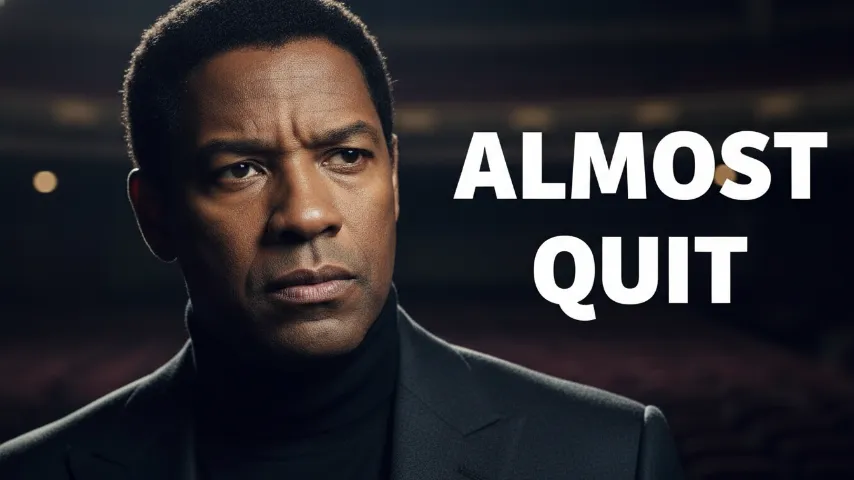
In a candid moment shared in a past interview, Washington admitted that he seriously considered walking away from acting. “There was a time when I almost quit,” he revealed. “I thought, ‘Maybe this isn’t for me. Maybe I should go back to school, get a real job.’” The dream that once burned brightly now flickered under the weight of reality.
It was during this low point that a mentor intervened. A fellow actor, recognizing Washington’s raw talent and quiet determination, pulled him aside and said, “Don’t leave, man. You’re too good.” Those words, simple yet profound, became a turning point. They weren’t just encouragement—they were a lifeline.
The Role That Changed Everything
Washington’s first paid acting role came through a summer theater production in 1976, but it was his performance in the 1981 film Carbon Copy that marked his official entry into Hollywood. Still, success didn’t come overnight. He continued to face typecasting and limited opportunities, often being offered roles that leaned heavily on stereotypes.
His big break came in 1987 with Cry Freedom, where he portrayed anti-apartheid activist Steve Biko. The role earned him an Academy Award nomination for Best Supporting Actor and signaled to the industry that he was more than just a promising newcomer—he was a force to be reckoned with.
Yet even as his career began to gain momentum, Washington remained introspective about his journey. He often reflected on how close he came to giving up, and how the support of those who believed in him made all the difference. “I didn’t know if I’d ever get a real shot,” he said in a 2018 interview. “But I kept showing up.”
The Hidden Battles Behind the Calm
What the public rarely sees is the inner turmoil that accompanied Washington’s rise. Behind the calm demeanor and measured speech lies a man who has wrestled with doubt, pressure, and the fear of failure. In a 2020 documentary, he described moments of intense self-scrutiny, especially after roles that didn’t resonate with audiences or critics.
One such moment came after he turned down a major film early in his career—a decision he later referred to as “the biggest regret of my career.” Though he initially felt the story was too dark and brutal, he admitted in a later interview that he “messed it all up” by underestimating its potential. “I just didn’t think anybody was going to see it,” he confessed. “I don’t know what I was thinking.”
These reflections reveal a vulnerability that contrasts sharply with his on-screen persona. They also underscore a key truth: even legends face moments of uncertainty. Washington’s ability to persevere through those moments is what sets him apart—not just as an actor, but as a human being.
A Shift in Focus: From Screen to Behind the Scenes
In recent years, Washington has hinted at a gradual shift away from acting. In a 2023 interview, he suggested that his focus is increasingly turning toward behind-the-scenes work, including directing and mentoring young talent. “I’m not done,” he clarified, “but I’m thinking about what comes next.”
This evolution is not surprising given his long-standing commitment to education and the arts. He has repeatedly emphasized the importance of giving back, often citing his own mentors as pivotal influences. “Someone saw something in me when I didn’t see it in myself,” he said. “Now it’s my turn.”
Despite his growing interest in directing, Washington continues to deliver powerful performances. His 2022 role in The Tragedy of Macbeth showcased his enduring mastery of Shakespeare, while his portrayal of Macbeth earned widespread critical acclaim. Even as he contemplates a quieter chapter, his presence on screen remains commanding.
The Legacy of Perseverance
Denzel Washington’s story is more than a tale of fame and fortune—it’s a testament to resilience. His near-decision to leave acting serves as a powerful reminder that even the most accomplished individuals face moments of doubt. What matters is not the absence of struggle, but the courage to keep going.
His journey also highlights the importance of mentorship and community in the arts. Without the encouragement of those who believed in him, Washington might have walked away from a career that would go on to inspire millions. Today, he pays that belief forward, supporting emerging artists and advocating for greater diversity in Hollywood.
Looking Ahead: A Quiet Revolution
As Washington enters the later stages of his career, he remains a symbol of excellence and integrity. He no longer watches movies, including his own, a fact he shared in a 2021 interview, explaining that after more than 40 years in the industry, he’s “tired of movies.” Yet his influence endures—not just through his films, but through the lives he’s touched.
His legacy is not defined solely by awards or box office numbers, but by the quiet strength he’s shown in the face of adversity. He has redefined what it means to be a leading man—not through bravado, but through depth, discipline, and an unwavering commitment to his craft.
Frequently Asked Questions
Why did Denzel Washington almost quit acting?
Denzel Washington almost quit acting after facing repeated rejections and being told he wasn’t good enough to join his acting school’s company. For nearly a decade, he struggled to land film roles, which led to deep self-doubt.
What kept Denzel Washington from leaving acting?
A fellow actor and mentor encouraged him, telling him, “Don’t leave, man. You’re too good.” This support helped Washington regain confidence and continue pursuing his career.
What was Denzel Washington’s first major film role?
His first major film role was in Carbon Copy (1981), but his breakthrough came with Cry Freedom (1987), which earned him an Academy Award nomination.
Has Denzel Washington ever regretted a role?
Yes, Washington has admitted to regretting turning down a major film early in his career, calling it “the biggest regret of my career” in a past interview.
Is Denzel Washington retiring from acting?
While he has hinted at shifting focus to directing and mentoring, Washington has not announced a full retirement and continues to take on select roles.
What is Denzel Washington’s legacy beyond acting?
Beyond his performances, Washington is celebrated for his resilience, mentorship, and commitment to uplifting the next generation of artists in the entertainment industry.