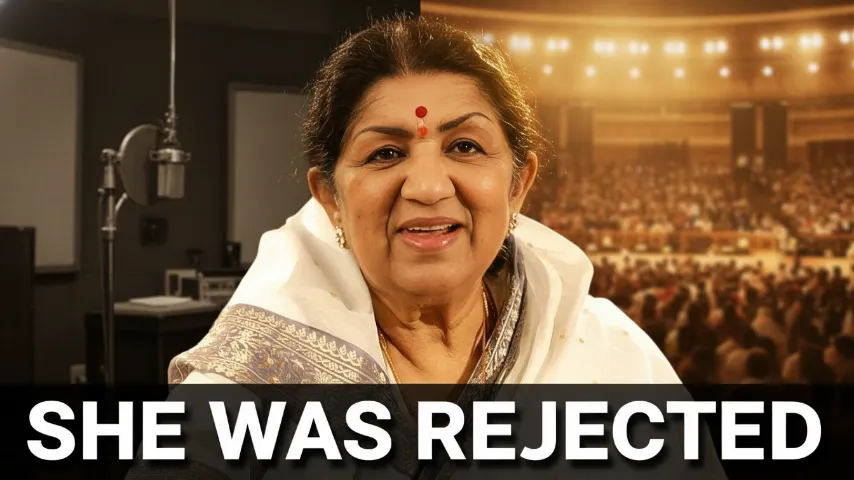
Untold Story of Lata Mangeshkar:
Lata Mangeshkar, often revered as the “Nightingale of India,” began her journey in music not with applause, but with silence specifically, the silence that followed rejection. In 1942, at just 13 years old, she stepped into the world of professional singing, a time when India was still under colonial rule and the film industry was dominated by established voices. According to the National Herald, she started singing five years before independence, marking the beginning of a career that would span over seven decades.
Key Takeaways
- Lata Mangeshkar began her professional singing career in 1942 at the age of 13, just five years before India’s independence.
- Despite early rejections due to her “thin” or “squeaky” voice, she persevered to become one of the most celebrated playback singers in Indian cinema.
- Her journey mirrors the evolution of independent India, making her not just a musical icon but a cultural symbol of resilience and national pride.
Her first recorded song was for a Marathi film in 1942, a modest beginning for what would become a legendary legacy. Yet, her entry into Bollywood was far from smooth. As noted in multiple sources, including The Economic Times and Times of India, Lata faced immediate resistance from industry gatekeepers who questioned the suitability of her voice. One of the most cited rejections came from music director Naushad, who reportedly dismissed her after a trial, calling her voice “squeaky” and unfit for playback singing.
This early setback could have ended her dreams. But Lata Mangeshkar, born into a family steeped in classical music her father, Deenanath Mangeshkar, was a renowned classical vocalist and theater actor was no stranger to discipline and dedication. She trained rigorously in Hindustani classical music, honing her voice with a precision that would later define her artistry. Her perseverance was not just personal; it was a quiet rebellion against an industry that often judged talent through narrow lenses.
In those early years, playback singing was still an evolving concept in Indian cinema. The 1940s saw the dominance of singers like Noor Jehan and Shamshad Begum, whose voices carried a certain boldness and maturity. Lata’s voice, by contrast, was lighter, more ethereal qualities that were initially seen as weaknesses. As reported in archival accounts, some producers and directors believed her tone lacked the emotional depth required for cinematic expression.
Yet, it was precisely this unique timbre that would later become her signature. Her ability to convey subtle emotions longing, devotion, joy, sorrow with a clarity and purity that few could match began to set her apart. By the late 1940s, she started gaining recognition, particularly through collaborations with music directors like Ghulam Haider and Anil Biswas. Haider, in particular, played a pivotal role in shaping her early career, giving her opportunities that allowed her to experiment and grow.
Her breakthrough came with the song “Dil Mera Toda, Mujhe Kahin Ka Na Chhora” from the 1948 film Hamari Baat. Though the film itself was not a major success, the song showcased her ability to carry complex emotions with restraint and grace. It was a turning point. From then on, her career began to gain momentum, slowly but steadily.
The 1950s marked the golden era of Lata Mangeshkar’s rise. She became the voice behind some of the most iconic heroines of Hindi cinema, including Nargis, Vyjayanthimala, and Mala Sinha. Her collaboration with music director S.D. Burman and later R.D. Burman produced timeless melodies that remain etched in the collective memory of the nation. Songs like “Aaja Re Pardesi” from Madhumati (1958) and “Lag Jaa Gale” from Woh Kaun Thi? (1964) are not just musical masterpieces they are emotional landmarks in Indian cultural history.
What set Lata apart was not just her technical mastery, but her emotional intelligence. She had an uncanny ability to adapt her voice to the character on screen, whether it was the innocence of a village girl or the sophistication of a city dweller. This versatility made her indispensable to filmmakers. As noted in The Economic Times, a few songs by Lata could act as a “security blanket” for a film producer her involvement often guaranteed a film’s musical success.
Her influence extended beyond entertainment. Lata Mangeshkar’s voice became a unifying force in a newly independent India. During times of national crisis be it wars, natural disasters, or moments of collective grief her songs provided solace and strength. She lent her voice to patriotic anthems like “Aye Mere Watan Ke Logo”, composed by C. Ramchandra and written by Kavi Pradeep, which moved an entire nation to tears when performed live in 1963. Prime Minister Jawaharlal Nehru reportedly said the song brought the audience to its feet, a rare moment of national unity through music.
Her commitment to her craft was legendary. She was known for her punctuality, professionalism, and refusal to compromise on quality. She recorded over 25,000 songs in more than 36 languages, a feat that earned her a place in the Guinness World Records. Yet, despite her monumental success, she remained humble and grounded. In past interviews, she often credited her father and gurus for instilling in her a sense of discipline and devotion to music.
Lata Mangeshkar’s journey was not without personal sacrifices. She never married, choosing instead to dedicate her life to music and her family. Her younger sister, Asha Bhosle, also became a legendary playback singer, creating one of the most celebrated musical duos in Indian history. Their contrasting styles Lata’s classical purity versus Asha’s versatility and modern flair enriched Indian music and expanded the boundaries of playback singing.
Her legacy is not confined to film music. She was a torchbearer of Indian classical traditions, often blending ragas into film compositions with seamless artistry. She received numerous accolades, including the Bharat Ratna in 2001, India’s highest civilian honor. Yet, she remained accessible, often attending music events and mentoring young artists.
Even in her later years, Lata Mangeshkar’s voice retained its clarity and emotional depth. She continued to record songs well into her 80s, a testament to her enduring passion. Her final public appearance was in 2019, when she attended a function to honor her late brother, Hridaynath Mangeshkar, a renowned composer in his own right.
She passed away on February 6, 2022, at the age of 92, after being hospitalized for complications related to Covid-19. Her death marked the end of an era. Tributes poured in from across the globe, with leaders, artists, and millions of fans mourning the loss of a cultural icon.
Yet, her voice lives on—in the songs that continue to play on radio stations, in the hearts of those who grew up listening to her, and in the aspirations of new generations of singers. As The Economic Times aptly noted, “We grew up listening to the voice of Lata Mangeshkar… whether in joy or sorrow, her voice was always there.”
Her story is more than a tale of musical excellence. It is a narrative of resilience, of rising above rejection, of transforming perceived weaknesses into strengths. In a nation that often celebrates loudness and boldness, Lata Mangeshkar proved that subtlety, discipline, and purity could command the same if not greater respect.
She was not just a singer. She was a symbol of India’s cultural evolution, a voice that echoed through the corridors of time, witnessing the birth of a nation and growing alongside it. From a young girl rejected for her “thin” voice to the “Voice of the Nation,” Lata Mangeshkar’s journey is a testament to the power of perseverance, artistry, and unwavering dedication.
FAQs
When did Lata Mangeshkar begin her singing career?
Lata Mangeshkar began her professional singing career in 1942 at the age of 13, as confirmed by the National Herald.
Why was Lata Mangeshkar initially rejected by the film industry?
She was rejected by several music directors, including Naushad, who reportedly found her voice “squeaky” or “too thin” for playback singing, according to archival reports and industry sources.
What was Lata Mangeshkar’s first recorded song?
Her first recorded song was for a Marathi film in 1942, marking the start of her long and illustrious journey in Indian music.
How many songs did Lata Mangeshkar record in her lifetime?
She recorded over 25,000 songs in more than 36 languages, earning her a place in the Guinness World Records.
What role did Lata Mangeshkar play in India’s cultural history?
Her voice became a unifying force in post-independence India, providing emotional and cultural continuity through decades of social and political change.
What awards did Lata Mangeshkar receive?
She was honored with numerous awards, including the Bharat Ratna in 2001, the Padma Vibhushan, and the Dadasaheb Phalke Award, among others.
Did Lata Mangeshkar ever marry?
No, she never married and dedicated her life to music and her family.